U.S. Hemp Is Growing Again — But the Numbers Tell Three Very Different Stories
The latest USDA hemp report shows a larger American crop, rapidly expanding grain production and significantly more fiber. But acreage alone doesn't tell us whether a hemp market is healthy.**
After several difficult years of contraction and uncertainty, the latest national numbers show something the U.S. hemp industry badly needed: growth.
According to USDA's National Agricultural Statistics Service, the value of American hemp production reached $739 million in 2025, an increase of 64 percent from the previous year. Farmers planted 49,267 acres of hemp outdoors, while harvested acreage increased 34 percent to 43,707 acres.
Those are encouraging numbers.
But underneath the headline, three very different hemp economies are developing.
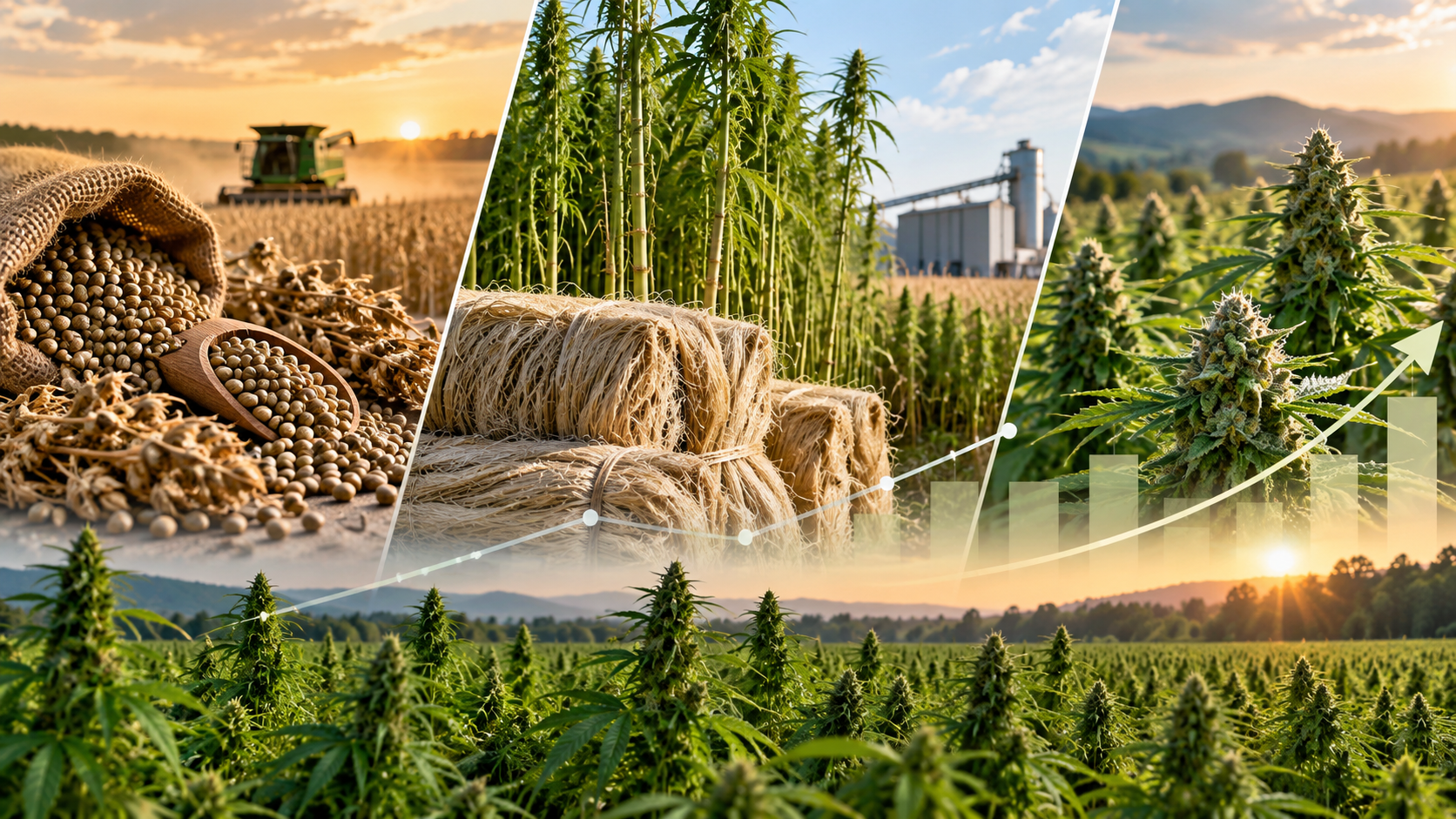
Floral hemp continues to account for the overwhelming majority of crop value. Grain hemp is expanding quickly from a relatively small base. Fiber production is growing, but its economics show why increasing acreage alone will not build a durable industrial hemp industry.
That distinction matters as farmers, processors, manufacturers and investors decide where the next stage of the hemp industry will come from.
Grain Hemp Is Starting to Look Like an Agricultural Crop
One of the most interesting changes is happening in grain.
U.S. farmers harvested approximately 7.26 million pounds of hemp grain in 2025, more than double the previous year's production. Harvested grain acreage increased to 7,515 acres, while average yield climbed to 966 pounds per acre.
The value of grain hemp production increased even faster, reaching approximately $8.09 million — up 209 percent from 2024.
Grain is still a relatively small segment of the overall hemp economy, but the direction is important.
Unlike markets built primarily around cannabinoids, hemp grain can move into familiar agricultural and food channels. Hemp seed can become food ingredients, protein, oil and animal-feed products where permitted. The residual materials from processing can create additional opportunities.
More importantly, grain production starts to resemble agriculture that farmers already understand.
A producer can evaluate acres, yield, contracts, transportation costs and commodity pricing. Those numbers may not always be attractive, but they are measurable.
That makes grain hemp fundamentally different from a market built around chasing the price of a single high-value compound.
Fiber Production Is Growing — But Processing Is Still the Constraint
Fiber hemp provides another encouraging signal.
American farmers produced about 67.3 million pounds of hemp grown for fiber in 2025, an increase of 11 percent. Harvested acreage reached 21,693 acres, up 14 percent.
Those figures demonstrate something important: American farmers can grow industrial hemp at meaningful scale.
The harder question comes after harvest.
Despite increased production, USDA estimated the value of the 2025 fiber crop at only $13.5 million, down 13 percent from the previous year.
That is a reminder that producing more raw material does not automatically create a stronger industry.
Fiber hemp needs somewhere to go.
The stalk contains two major raw materials. The long outer bast fiber can be used in textiles, composites, insulation and other manufactured products. The woody inner portion, generally called hurd or shiv, can be used in animal bedding, hemp-lime construction and other applications.
Turning a harvested hemp stalk into consistent, manufacturer-ready material requires decortication, cleaning, separation, grading, storage and transportation.
Those steps require equipment and capital.
A field of hemp may be impressive, but the real industrial opportunity begins when that crop can reliably become a specification-grade input for a manufacturer.
That remains one of the industry's biggest challenges.
The Next Hemp Industry Will Be Built Between the Farm and the Factory
Industrial hemp is sometimes discussed as though the primary challenge is convincing farmers to plant it.
That may have been true during the earliest years following federal legalization.
Today the bigger challenge is building the infrastructure connecting farms to customers.
A manufacturer considering hemp fiber does not simply need someone willing to grow hemp. It needs a dependable supply of material with predictable characteristics, delivered at a competitive cost.
A builder using hemp-lime needs consistent hurd.
A composite manufacturer needs fiber that meets production specifications.
A food company needs grain that meets food-safety, quality and volume requirements.
A farmer, meanwhile, needs enough certainty to justify putting acres into the crop.
That creates a classic agricultural development problem.
Processors need acreage before investing in equipment. Farmers want reliable processors and buyers before committing acreage. Manufacturers want dependable processed material before redesigning products or supply chains.
Successful regional hemp industries will be the ones that solve those pieces together.
Floral Hemp Still Dominates the Dollar Value
The USDA numbers also make clear how strongly cannabinoids continue to influence hemp economics.
Outdoor floral hemp production reached approximately 33.2 million pounds in 2025, up 60 percent from 2024. USDA estimated its value at approximately $574 million.
That means floral production accounts for the majority of the reported value of the American hemp crop even though fiber occupies more harvested acreage.
This does not make floral hemp inherently better or worse than fiber or grain. They are simply different businesses.
Floral hemp can produce much higher value per acre, but it also comes with different production requirements, labor needs, regulatory risks and market dynamics.
Industrial fiber and grain are generally lower-value bulk agricultural products. Their opportunity comes from scale, efficient processing and integration into large existing industries.
Confusing those markets has caused problems for hemp since legalization.
The long-term industrial opportunity is not necessarily about replacing one hemp market with another. It is about allowing several distinct hemp supply chains to mature according to their own economics.
More Acres Are Encouraging. More Customers Matter More.
The USDA report should give the hemp industry some reason for optimism.
Total harvested acreage is growing. Grain production is expanding rapidly. Fiber acreage is moving upward. Farmers are demonstrating that the crop can be produced commercially across the United States.
But the industry should resist measuring success only by acres planted.
A sustainable agricultural industry ultimately needs customers.
For hemp, that means more food manufacturers buying hemp ingredients. More construction companies using hemp-based materials. More insulation, composite, paper and packaging companies testing fiber. More processors capable of turning regional crops into dependable industrial feedstocks.
Every new customer makes the next acre easier to justify.
That is how agricultural industries become durable.
Hemp Doesn't Need Another Boom
The early years of legal hemp produced extraordinary expectations. Acreage expanded rapidly, particularly around cannabinoid production, before processing capacity and consumer demand were ready to support it.
The industry does not need to repeat that cycle.
A slower form of growth may ultimately prove much healthier.
A few thousand additional acres connected to working processors and committed customers can be more valuable than tens of thousands of speculative acres.
The 2025 USDA numbers suggest portions of the hemp industry may finally be moving in that direction.
Grain is gaining volume.
Fiber production is increasing.
Building materials and other industrial applications are creating new reasons to develop processing capacity.
And growers increasingly understand that having a market before planting is more important than having an exciting story about what hemp might someday become.
There is still a considerable distance between today's hemp industry and a mature American commodity supply chain.
But the latest numbers show that there is something real to build upon.
The next milestone should not simply be more hemp in the ground.
It should be more American-grown hemp moving reliably from farm, to processor, to manufacturer, to customer.
That is when acreage becomes an industry.
Source: USDA National Agricultural Statistics Service, 2025 National Hemp Report, released April 16, 2026.