Medicare’s CBD Move Could Change the Future of Hemp
For years, the hemp industry has argued that Congress and regulators need to distinguish between non-intoxicating hemp products such as CBD and products designed primarily to produce a THC high.
Now one of the federal government’s largest healthcare agencies is making essentially the same distinction.
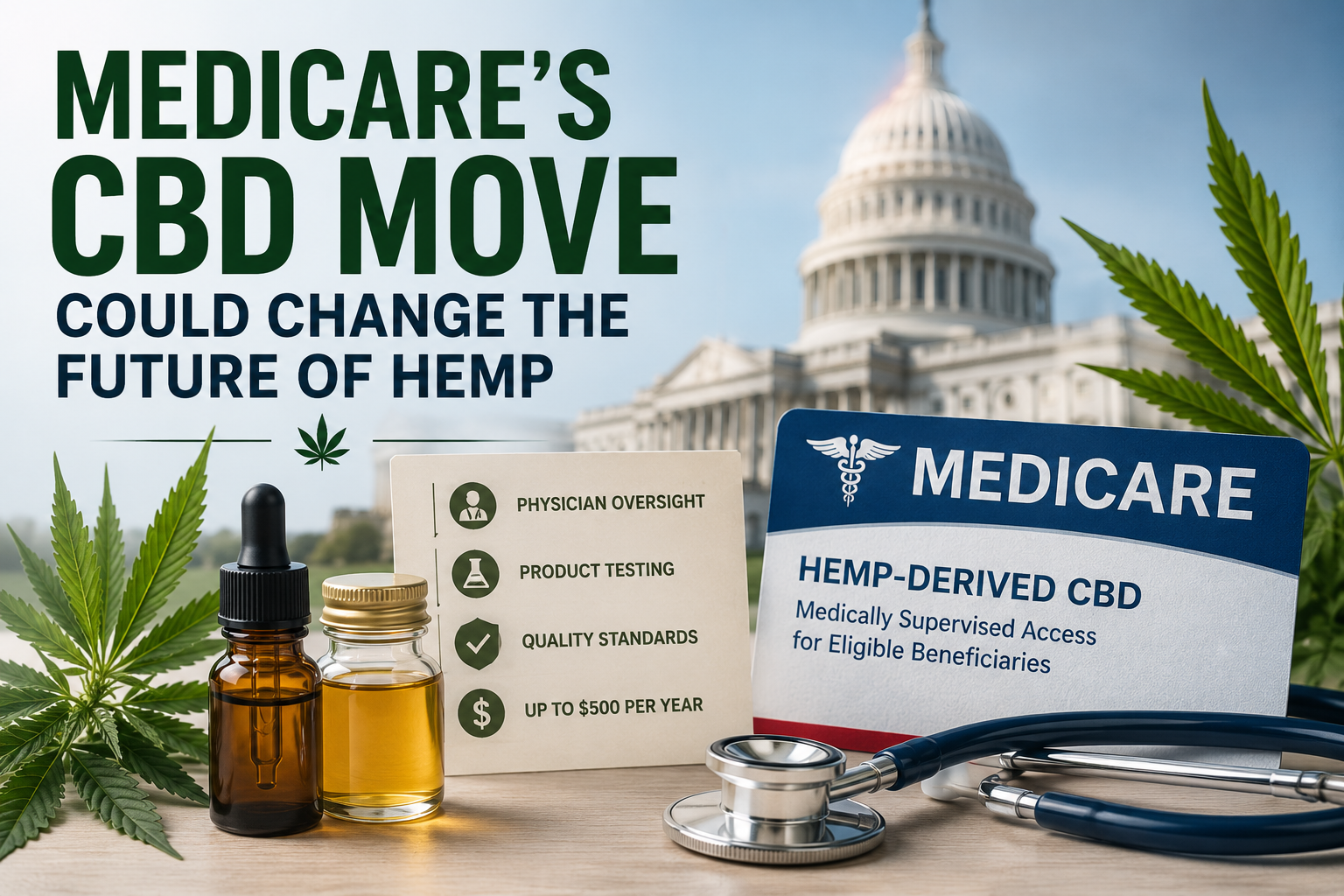
The Centers for Medicare & Medicaid Services (CMS), led by Administrator Dr. Mehmet Oz, has created a program allowing certain participating healthcare organizations to provide eligible patients with up to $500 per year in qualifying hemp-derived products. The initiative is focused largely on products such as CBD and includes physician involvement, medication review, product testing and other safeguards.
That alone is a remarkable development for an industry that only regained federal legal status eight years ago.
But it is happening at exactly the same time that another federal law threatens to eliminate many of the full-spectrum CBD products that CMS is attempting to make available.
This Is Not Simply “Medicare Pays for CBD”
The details are important.
CMS calls the program the Substance Access Beneficiary Engagement Incentive. Participating organizations in certain CMS Innovation Center healthcare models can choose to furnish qualifying hemp products to eligible beneficiaries, with a value of up to $500 annually.
Consumers cannot simply purchase CBD at a store and send the receipt to Medicare for reimbursement. CMS specifically states that Medicare does not reimburse the healthcare organization for the products and beneficiaries should not submit Medicare claims for them.
Instead, qualifying products must be furnished through participating healthcare organizations under medical supervision. A physician must determine that their use is appropriate, discuss potential benefits and risks, review the patient's medications for possible interactions and establish appropriate follow-up.
That distinction is important.
This isn't the federal government opening the door to an unregulated cannabinoid marketplace.
It is the federal government beginning to build a regulated, medically supervised pathway for hemp-derived products.
Look at the Standards CMS Is Requiring
The product standards may be even more significant to the hemp industry than the $500 figure.
CMS requires eligible products to come from legally compliant sources and high-quality farms. Products must undergo third-party testing for cannabinoid potency as well as contaminants and microbial hazards.
Inhalable products are excluded. Products containing cannabinoids that are not naturally produced, or capable of being naturally produced, by the cannabis plant are also excluded. Oral products cannot contain more than 3 milligrams per serving of tetrahydrocannabinols under the current program requirements.
That looks much more like the regulatory framework responsible hemp businesses have been asking government to create:
Know where the product came from. Test it. Label it accurately. Establish appropriate potency limits. Protect consumers. Keep synthetic and converted intoxicants separate from legitimate hemp products.
Regulation does not have to mean prohibition.
The Federal Contradiction
Unfortunately, Congress created a major problem in November 2025.
Federal legislation changed the definition of hemp and is scheduled to take effect on November 12, 2026. Among other changes, the law establishes an extremely restrictive limit of 0.4 milligrams of total THC per container for finished hemp-derived cannabinoid products.
That is not merely a restriction on products designed to intoxicate consumers.
Because naturally produced full-spectrum CBD can contain trace amounts of THC, the new definition threatens many ordinary CBD products as well.
CMS acknowledges this problem directly. Its own guidance states that if federal hemp limits change under Section 781 of the FY2026 Agriculture Appropriations Act, CMS will have to change its definition of eligible hemp products accordingly.
In other words, one arm of the federal government is creating a carefully controlled pathway for physicians and healthcare organizations to provide tested hemp products while another federal law may make many of those products federally unlawful.
That makes no sense.
Dr. Oz Steps Into the Hemp Debate
Dr. Oz has now taken the unusual step of directly urging senators to protect the ability of CMS programs to continue providing qualifying full-spectrum hemp-derived CBD.
In his August 7 letter to senators, Oz warned that allowing the upcoming hemp restrictions to proceed unchanged could undermine access to clinically appropriate full-spectrum CBD for seniors and people with disabilities participating in Medicare programs.
The Senate subsequently rejected an amendment that would have removed a temporary delay of the new hemp restrictions. The vote was 61-32.
The Senate-passed legislation would move the effective date from November 12 to December 11, 2026, while moving forward with restrictions on synthetic hemp derivatives. As of August 10, however, the legislation still must be approved by the House of Representatives.
A one-month delay is obviously not a solution.
But the debate may finally be moving toward the right question.
Instead of asking whether government should simply “ban hemp THC,” Congress should determine which products are intoxicating, which products are non-intoxicating, and what reasonable standards are necessary for each.
This Matters Far Beyond CBD Companies
A legitimate CBD market creates demand throughout the agricultural supply chain.
Farmers grow cannabinoid hemp. Processors extract and refine it. Laboratories test it. Manufacturers formulate finished products. Retailers and healthcare providers distribute those products.
If medically supervised hemp products eventually become a meaningful part of healthcare, the market could become especially important for an aging American population.
More importantly, participation in healthcare markets will reward the businesses capable of demonstrating consistent potency, clean testing, documented sourcing and professional manufacturing practices.
That should be viewed as an opportunity rather than a burden.
Responsible hemp producers have spent years asking for standards that separate them from companies selling questionable products with inaccurate labels or chemically converted intoxicating cannabinoids.
CMS is beginning to create exactly that separation.
Michigan Should Be Paying Attention
The timing is particularly important in Michigan.
Michigan's Cannabis Regulatory Agency is currently working through major revisions to its marijuana administrative rules, including provisions affecting industrial hemp. A second public hearing on the proposed rules was held July 23, and the rulemaking remains pending.
Michigan therefore has an opportunity to learn from what is happening at the federal level.
The goal should not be to treat every product originating from Cannabis sativa L. as though it were marijuana.
Michigan should distinguish between intended use and actual risk.
Chemically converting inexpensive hemp-derived CBD into intoxicating THC is fundamentally different from producing hemp grain, seed oil, fiber, hurd, foods, compliant flower, naturally derived CBD oils, cosmetics or topical products.
Those differences should matter in regulation.
Michigan absolutely should have enforceable standards for cannabinoid products: appropriate licensing, sanitation, accurate labeling, traceability, complaint and recall procedures, representative sampling, qualified laboratories and scientifically appropriate contaminant and potency testing.
What it should not do is unnecessarily force federally lawful, non-intoxicating hemp into a regulatory system designed for marijuana.
CMS provides an interesting model. Its requirements emphasize compliant sourcing, testing, documentation, medical oversight and product safety. That is a risk-based system designed around what the product actually is and how it will be used.
Michigan policymakers should take notice.
A Better Path for Hemp
The hemp industry does not need another loophole.
It needs clear rules.
Congress can prohibit dangerous synthetic cannabinoids, establish reasonable age restrictions for intoxicating products, require independent laboratory testing, demand accurate labeling and hold irresponsible manufacturers accountable without destroying the legitimate CBD market in the process.
States can do the same.
And CBD manufacturers that want access to physicians, seniors and healthcare organizations should expect higher standards for manufacturing consistency, documentation and testing.
That is how a legitimate industry matures.
The Medicare development may therefore represent something larger than a new market opportunity for CBD.
It could mark the beginning of a long-overdue federal recognition that hemp-derived cannabinoids should be regulated according to their actual characteristics, risks and intended uses — rather than placing non-intoxicating CBD, synthetic intoxicants and marijuana into the same regulatory bucket.
That distinction will determine whether American farmers and manufacturers have an opportunity to build a responsible hemp industry or watch another promising agricultural market disappear through poorly targeted regulation.
Congress now has an opportunity to get that distinction right.
Michigan does too.