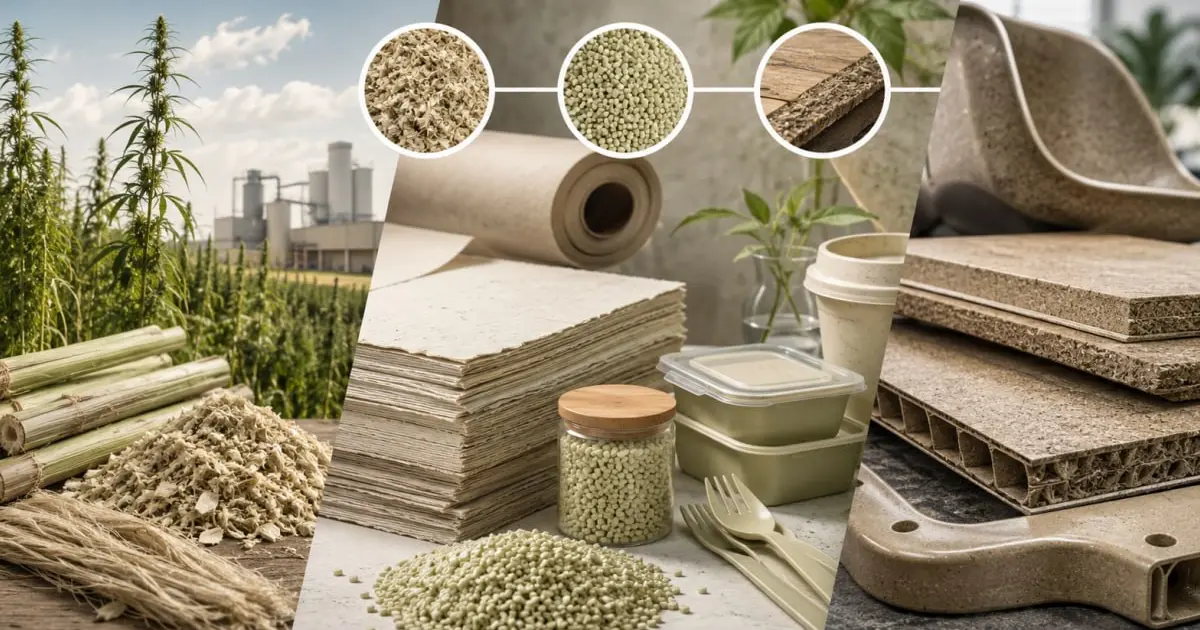
Hemp Paper, Bioplastics, and Composites: The Industrial Material Revolution Most People Are Missing
The Industrial Hemp Story Nobody's Telling
When most people think about hemp, they think about fiber, CBD, or fabric. That's understandable — those categories get nearly all the headlines. But there's a quieter, more consequential story unfolding in industrial manufacturing, and it involves materials that could reshape how we make paper, plastics, and composite structures for decades to come.
Hemp's return to legal cultivation status under the 2018 Farm Bill (defined as Cannabis sativa L. with a delta-9 THC concentration at or below 0.3% dry weight) cracked open a door for industrial applications that had been legally closed for generations. What's behind that door is more interesting than most people realize.
Hemp Paper: Trees Aren't the Only Option
Commercial paper production has been dominated by wood pulp for over a century, but hemp offers distinct advantages that are hard to ignore. Hemp stalks yield both bast fiber (the long outer fibers) and hurd — the woody inner core — and both can be pulped for paper production.
Hemp paper requires fewer chemical inputs during processing compared to wood pulp, and hemp crops reach harvest maturity in approximately 90 to 120 days, compared to the decades-long growth cycle of trees used for pulp. Archival records suggest hemp paper is also more resistant to yellowing and degradation over time.
The primary challenge isn't agricultural — it's infrastructure. North American paper mill infrastructure was built for wood fiber, and retrofitting or building new processing lines for hemp represents significant capital investment. That gap is narrowing as interest from sustainability-focused manufacturers grows, but large-scale commercial hemp paper production in the United States remains in early stages.
Hemp Bioplastics: Rethinking the Plastic Problem
Petroleum-derived plastics persist in landfills and waterways for hundreds of years. Hemp-based bioplastics, by contrast, are designed to be biodegradable — and hemp cellulose provides a high-quality feedstock for their production.
Hemp bioplastics can be processed into films, molded components, and packaging materials. They are not yet cost-competitive across all applications with petroleum plastics at scale, but that gap closes as fossil fuel costs remain volatile and regulatory pressure on single-use plastics increases in states like California, which has pursued some of the most aggressive plastic reduction policy in the country.
The California Department of Resources Recycling and Recovery (CalRecycle) continues to expand its oversight of packaging materials. Hemp bioplastics hold potential as a compliant alternative for brands navigating California's evolving packaging regulations — as of this publication date, manufacturers should verify current requirements directly with CalRecycle before making sourcing decisions.
Hemp Composites: Strong Enough for Cars and Buildings
Perhaps the most underreported hemp industrial application is composite materials — combinations of hemp fiber with resins or other binders that produce structural panels, insulation, and components used in automotive interiors, construction, and consumer products.
Several European automotive manufacturers have adopted natural fiber composites including hemp fiber for door panels and trunk liners, citing reduced weight and respectable tensile strength relative to fiberglass. (For specific manufacturer applications, readers should consult current automaker sustainability reports and peer-reviewed research on natural fiber reinforced polymer composites to confirm specific hemp fiber use.) These applications reduce vehicle weight, which supports fuel efficiency and reduces emissions over a vehicle's lifetime.
In construction, hemp fiber composites and hempcrete (a mixture of hemp hurd, lime, and water) provide insulating and structural properties with a lower embodied carbon footprint than conventional concrete.
From Vision to Reality: iHemp Manufacturing's Hemp Frisbees
One example of industrial hemp manufacturing closer to home: iHemp Manufacturing has produced hemp-composite Frisbees — a tangible demonstration that hemp's material properties translate into consumer products beyond apparel and supplements.
That project also surfaced a challenge many hemp manufacturers know well: accessing basic financial services. Despite operating in full compliance with federal and state law, iHemp Manufacturing encountered significant difficulty securing a bank account for its manufacturing operations. Banks continue to apply blanket caution to hemp-related businesses, even those processing industrial hemp for clearly non-intoxicating consumer products. It's a friction point that slows the broader industrial hemp economy and one that advocates have pressed legislators to address.
Michigan's Legislative Landscape for Industrial Hemp
In Michigan, Senate Bill 608 and Senate Bill 609 were introduced in the 2025–2026 legislative session and referred to the Senate Agriculture, Forestry, and Tourism Committee. These bills address hemp program structure and licensing. As of this publication date, committee action on these bills is pending; readers should verify current status with the Michigan Legislature's bill tracker before relying on any status reflected here.
The Michigan Department of Agriculture and Rural Development (MDARD) administered the state hemp program under the 2018 Farm Bill framework. The licensed hemp grower base in Michigan contracted significantly from the program's early years. This contraction underscores the need for policy stability if Michigan is to develop the grower base that industrial hemp manufacturing requires.
The Bigger Picture
Hemp paper, bioplastics, and composites aren't niche curiosities. They represent a materials supply chain with real commercial logic: renewable feedstocks, faster crop cycles, biodegradability, and in the case of composites, performance that competes with conventional inputs in specific applications.
The policy and infrastructure work happening now in states like Michigan and California determines whether American manufacturers will have access to domestically grown industrial hemp at the scale these markets require. That work matters — and being informed about it matters too.
If you want to stay ahead of hemp policy developments in your state, connect with your state hemp association and let your legislators know that industrial hemp manufacturing is an economic priority worth supporting.