Hemp as a Cover Crop: What Midwest Farmers Need to Know About Soil Health and Rotation
Hemp as a Cover Crop: What Midwest Farmers Need to Know About Soil Health and Rotation
For farmers across Indiana, Kentucky, Michigan, and Ohio, the pressure to protect topsoil, reduce input costs, and diversify rotation options is real and growing. Hemp — legally defined under the 2018 Farm Bill (Pub. L. 115-334) as Cannabis sativa L. with a delta-9 THC concentration of no more than 0.3 percent on a dry weight basis — is drawing renewed attention not just as a cash crop, but as a soil-building tool that fits naturally into Midwest rotations.
This article focuses specifically on hemp's agronomic benefits: what the soil science shows, how rotation timing works in the Midwest, and what farmers in these four states should know before they plant.
Why Soil Health Matters More Than Ever in the Midwest
The Corn Belt is under pressure. Decades of corn-soybean monocultures have compacted soils, reduced organic matter, and left many fields vulnerable to erosion and nutrient runoff. Cover crops — rye, clover, radish — have become standard tools for rebuilding soil biology between cash crop cycles. Hemp deserves a place in that conversation.
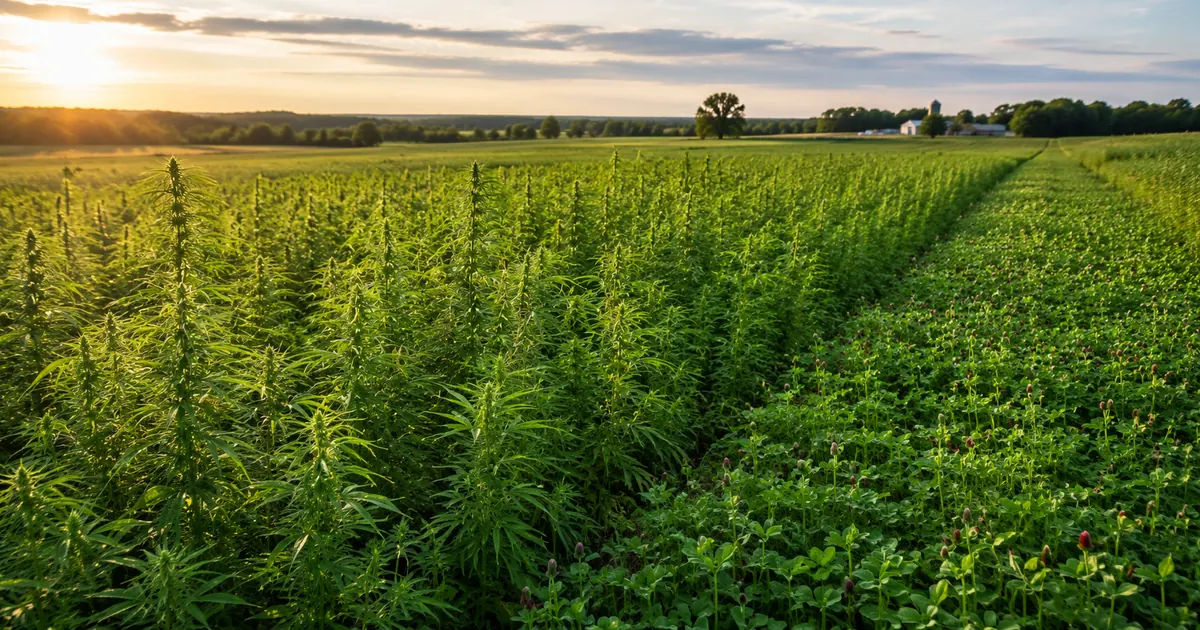
Hemp's deep taproot system — capable of penetrating 6 to 12 inches or more — mechanically breaks up compacted soil layers, improving water infiltration and aeration. (Bócsa, I. & Karus, M. (1998). The Cultivation of Hemp: Botany, Varieties, Cultivation and Harvesting. Hemptech; see also Amaducci, S. et al. (2015). Key cultivation techniques for hemp in Europe and China. Industrial Crops and Products, 68, 2–16.) Unlike shallow-rooted annual covers, hemp's root architecture creates lasting channels that benefit subsequent crops. Above ground, hemp's dense canopy suppresses weed pressure effectively, reducing herbicide dependency during the growing window.
Phytoremediation: What the Research Actually Shows
Phytoremediation refers to a plant's ability to extract, contain, or break down contaminants in soil. Hemp has been studied in this context since the early 1990s, most notably at the Chernobyl site in Ukraine, where Cannabis sativa was used to draw heavy metals — including cesium and strontium — from contaminated soil. The Chernobyl cesium and strontium field trials conducted by Phytotech, Inc. in the mid-1990s are documented in: Raskin, I. & Ensley, B.D. (Eds.) (2000). Phytoremediation of Toxic Metals: Using Plants to Clean Up the Environment. John Wiley & Sons. Hemp's capacity to accumulate cadmium, lead, and zinc from contaminated soils is confirmed in separate peer-reviewed research, including: Linger, P., Müssig, J., Fischer, H., & Kobert, J. (2002). Industrial hemp (Cannabis sativa L.) growing on heavy metal contaminated soil: fibre quality and phytoremediation potential. Industrial Crops and Products, 16(1), 33–42.
Closer to home, this science is being applied to one of Michigan agriculture's most urgent crises. A Michigan farm project is using hemp in combination with fungal remediation techniques — mycoremediation — as part of a collaborative, farmer-led effort to address PFAS (per- and polyfluoroalkyl substance) contamination on agricultural land. PFAS pollution is a significant and growing concern across Michigan farmland, and the combination of hemp's deep root uptake capacity with fungal decomposition pathways represents a promising integrated approach. iHempMichigan.com documents this work in detail: Fighting PFAS with Hemp, Fungi, and Farmers. Midwest farmers watching remediation science evolve should consider this Michigan case study an important data point.
An important caveat: hemp used for phytoremediation should never enter the food, feed, or fiber supply chain. Farmers using hemp in contaminated areas should work with their state department of agriculture and an agronomist before planting. As of the date of this publication, each state — Indiana, Kentucky, Michigan, and Ohio — operates its own hemp program under USDA oversight; contact your state program for current planting requirements and soil testing obligations before taking action.
For most Midwest farmers, the practical soil benefit is not heavy metal extraction but organic matter contribution. Hemp biomass incorporated after harvest builds carbon in the soil profile, supporting microbial activity and long-term fertility.
Hemp in Midwest Crop Rotations
Rotation compatibility is a practical question. Hemp fits most naturally ahead of small grains or between corn and soybean cycles, though exact timing depends on your county and state program licensing window.
- Indiana: The Indiana State Department of Agriculture (ISDA) administers hemp licensing. Producers must hold a valid license prior to planting — as of publication, applications are processed annually.
- Kentucky: The Kentucky Department of Agriculture (KDA) has one of the most established hemp programs in the country. Kentucky farmers have more local research and extension resources available than most other states in the region.
- Michigan: The Michigan Department of Agriculture and Rural Development (MDARD) oversees hemp licensing. Michigan's program includes specific sampling and testing requirements before harvest. Michigan farmers are also among the most active in exploring hemp's remediation potential on contaminated ground — work documented by iHempMichigan.com in their piece on fighting PFAS with hemp, fungi, and farmers.
- Ohio: The Ohio Department of Agriculture (ODA) manages the state hemp program. Ohio follows the federal delta-9 THC threshold of 0.3 percent dry weight per the 2018 Farm Bill.
Always verify current-year licensing deadlines and planting windows directly with your state program. Regulations can change between growing seasons.
Building Soil Carbon — and Carbon Value
Farmers incorporating hemp into rotation should know that soil carbon is increasingly recognized as a commodity, not just an agronomic asset. Programs like the one offered through Dynamic Carbon Credits (dynamiccarboncredits.com) (editorial mention; iHemp has no affiliate, referral, or compensated relationship with this organization) are creating pathways for Midwest farmers to generate income from soil carbon improvements — including through biochar application, which works synergistically with cover crop rotations by stabilizing soil organic matter for the long term. If you're rebuilding soil health through hemp rotation, it's worth exploring whether your operation qualifies.
Practical Considerations Before You Plant
- Hemp is not a weed suppressor in early stages — it requires weed-free conditions at establishment.
- Water needs are moderate; hemp generally does not require irrigation in Midwest summer conditions if planted at the right time.
- Hemp should not be grown on the same ground in consecutive years — standard best practice is a minimum three-year gap to reduce disease pressure.
- Confirm seed sourcing through compliant licensed varieties; certified seed sources reduce THC compliance risk at harvest.
Get Involved in Hemp Advocacy
Hemp farming in the Midwest is still building momentum. Whether you're a grain farmer curious about rotation options, a soil health advocate, or a producer already in the program, staying connected to the advocacy conversation matters. Visit your state hemp program website, attend local extension events, and connect with organizations working to shape the next farm bill and state-level hemp policy.
Hemp's role in Midwest agriculture is agronomic first — and the soil science backs it up. The more farmers engage with it, the stronger the data and the advocacy will become.