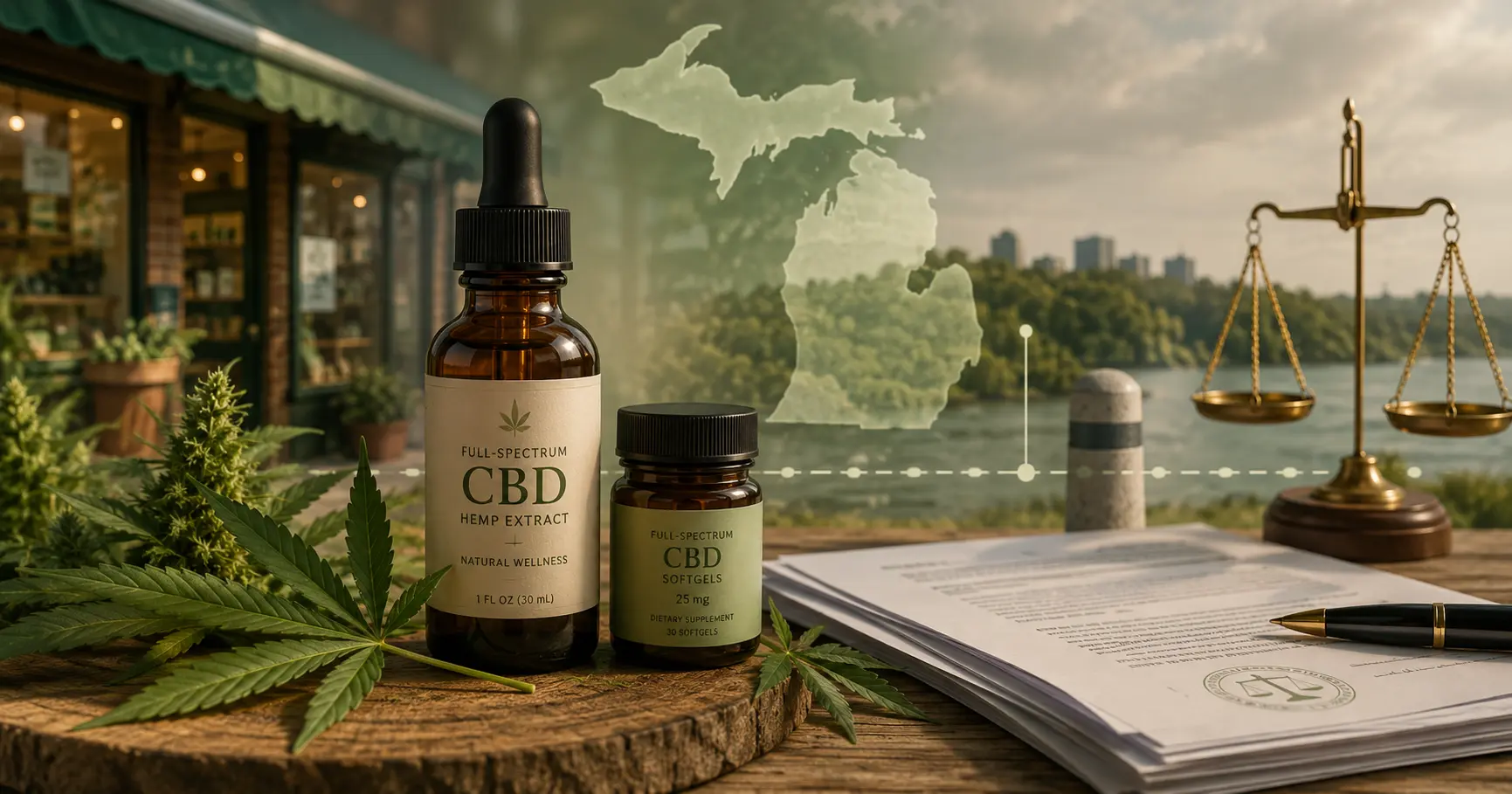
Full-Spectrum CBD: Why Michigan Faces a 2026 Hemp Cliff
Michigan hemp businesses are facing a federal policy issue that is easy to misunderstand.
This is not just another debate about intoxicating hemp products. It is not only about delta-8. It is not simply about whether the Food and Drug Administration may take a harder look at CBD products.
The bigger issue is the definition of hemp itself.
Under the 2018 Farm Bill, hemp was federally defined around a familiar threshold: Cannabis sativa L. and hemp derivatives containing no more than 0.3% delta-9 THC on a dry weight basis. That definition helped build a national hemp economy around fiber, grain, CBD, full-spectrum hemp extract, topicals, tinctures, gummies, capsules, and many other products.
But Section 781 of Public Law 119-37 changes the federal hemp definition. The amended federal definition now excludes certain hemp-derived cannabinoid products, including final hemp-derived cannabinoid products containing greater than 0.4 milligrams combined total THC per container. That combined total includes total tetrahydrocannabinols, including THCA, and certain cannabinoids with similar effects or marketed similar effects, as determined by federal authorities.
The effective date is widely understood to be November 12, 2026, one year after enactment. See the amended federal definition in 7 U.S.C. § 1639o and the Congressional Research Service summary, Changes to the Federal Definition of Hemp: Legal and Market Implications.
That 0.4 milligram per-container threshold is the problem full-spectrum CBD businesses cannot ignore.
The policy problem is that full-spectrum CBD products are intentionally designed to preserve a broader hemp profile, while the new federal definition may punish the trace THC that often comes with that profile.
Why Full-Spectrum CBD and the Entourage Effect Matter
Full-spectrum CBD products are not formulated the same way as CBD isolate products.
CBD isolate is designed to separate cannabidiol from the rest of the hemp plant’s natural profile. Full-spectrum hemp extract is different. It is typically designed to preserve a broader range of naturally occurring plant compounds, including CBD, minor cannabinoids, terpenes, flavonoids, and trace THC within lawful limits.
That whole-plant approach is often discussed through the “entourage effect” — the idea that cannabis and hemp compounds may interact in ways that differ from isolated single compounds.
The concept has been discussed in scientific literature for years. Dr. Ethan Russo’s widely cited 2011 review, “Taming THC: potential cannabis synergy and phytocannabinoid-terpenoid entourage effects,” examined how cannabinoids and terpenes may interact and contribute to the effects of cannabis-based extracts. See the PubMed abstract: Taming THC: potential cannabis synergy and phytocannabinoid-terpenoid entourage effects.
Other research has explored the difference between purified CBD and CBD-rich plant extracts. A 2015 study by Gallily, Yekhtin, and Hanuš compared purified CBD with a CBD-rich cannabis extract in an animal model and reported that the extract produced a clearer dose-response pattern than purified CBD alone. See: Overcoming the Bell-Shaped Dose-Response of Cannabidiol by Using Cannabis Extract Enriched in Cannabidiol.
More recent reviews are careful to note that the entourage effect remains scientifically debated. A 2023 review in Biomedicines described the entourage effect as a postulated concept and emphasized that more research is needed to clarify the mechanisms and strength of the evidence. See: The Entourage Effect: Terpenes Coupled with Cannabinoids for the Treatment of Mood Disorders and Anxiety Disorders. A 2024 review in Pharmaceuticals likewise noted that the concept is closely tied to the diversity of compounds in cannabis products, while also acknowledging ongoing debate over how well the effect has been proven. See: The Cannabis Entourage Effect: Current Status and Future Directions.
That debate is exactly why federal policy should be careful.
For Michigan businesses such as Thumb Coast CBD, full-spectrum CBD is not just a marketing phrase. It describes a product category built around preserving more of the hemp plant’s natural chemical profile. Kyle McCalmon, owner of Thumb Coast CBD, iHemp Michigan board member, and chair of the iHemp Michigan Cannabinoid Committee, has explained that many consumers choose full-spectrum products because they want the broader plant profile rather than isolated CBD alone.
That does not require making disease claims. It simply recognizes that full-spectrum CBD products are intentionally different from isolates.
A federal definition that sets a 0.4 milligram combined total THC limit per finished container could disrupt that entire category. Trace THC is part of why a product may be full spectrum. If the law treats that trace THC as the deciding factor, it may force companies to reformulate products away from full-spectrum hemp extract, even when those products are non-intoxicating and supported by third-party testing.
The Michigan Impact Is Local
This issue is not abstract in Michigan.
Thumb Coast CBD in St. Clair is one example of a Michigan hemp/CBD business built around local retail, product education, consumer trust, and third-party testing. Thumb Coast describes itself as a Michigan-grown, family-owned CBD company and states that its products are third-party lab tested with Certificates of Analysis available for review. See Thumb Coast CBD and its About Thumb Coast CBD page.
Its owner, Kyle McCalmon, also serves on the iHemp Michigan board of directors and chairs the iHemp Michigan Cannabinoid Committee.
Kyle’s perspective matters because he sits at the intersection of local business, product formulation, consumer education, and hemp policy. He understands that full-spectrum CBD products are not merely “CBD with THC.” They are products built around a broader hemp extract profile, where trace cannabinoids and terpenes are part of the formulation.
That is exactly why the federal definition change matters.
If the law treats trace THC in the final container as the deciding factor, it may fail to distinguish between intoxicating products and ordinary full-spectrum CBD products that consumers have used for years.
This Could Affect More Than One Store
Michigan’s hemp economy includes farmers, processors, formulators, retailers, wellness shops, professional service providers, packaging suppliers, testing labs, and consumers.
When federal law changes the definition of what counts as hemp, the impact does not stop at the label on a bottle. It can affect:
- Retail shelves
- Product formulation
- Farm demand
- Processor contracts
- Testing requirements
- Consumer access
- Small-business confidence
- Investment in Michigan hemp
That is the real concern.
A Michigan consumer may simply want a tested, transparent, full-spectrum hemp product from a local business. A Michigan retailer may simply want clear rules so they know what they can legally sell. A Michigan farmer may depend on demand from hemp processors and product makers. A Michigan CBD business may have spent years building customer trust, product records, lab testing practices, and compliant labeling.
A sudden federal definition change can disrupt all of that.
This Is Not Just an FDA Issue
The Food and Drug Administration remains part of the broader CBD policy problem. FDA continues to state that CBD and THC products are excluded from the dietary supplement definition under the Federal Food, Drug, and Cosmetic Act, unless FDA issues a regulation allowing such use. FDA also continues to state that CBD and THC generally cannot be added to conventional food products in interstate commerce under current law. See the FDA’s page, FDA Regulation of Cannabis and Cannabis-Derived Products, Including Cannabidiol (CBD).
That regulatory uncertainty has been a problem for years.
But the 2026 hemp-definition change is different.
The FDA issue concerns how CBD products are regulated as foods, supplements, drugs, cosmetics, or other product categories. The Section 781 issue goes deeper: whether certain products still qualify as hemp under federal law at all.
That is why the full-spectrum CBD community needs to stay focused on the correct issue.
The Policy Risk: A Rule Aimed at Intoxicating Hemp Could Catch Full-Spectrum CBD
Congress has legitimate concerns about intoxicating hemp products, youth access, synthetic cannabinoids, misleading marketing, and products sold without adequate testing or labeling.
Those concerns deserve serious regulation.
But regulation should be precise.
If the goal is to address intoxicating products, then the law should not unintentionally sweep in ordinary full-spectrum CBD products that are non-intoxicating, tested, and sold by responsible businesses.
A 0.4 milligram combined total THC limit per container may sound technical, but it could have a very real practical effect. Many full-spectrum products contain trace THC by design because they are preserving more of the hemp plant’s natural profile. The amount may be small, but when measured across an entire final container, it may exceed the new threshold.
That could push products out of the federal hemp category even when they are not the kind of intoxicating products policymakers say they are trying to target.
What Michigan Consumers Should Understand
Consumers should not panic. This change is not yet in effect, and businesses should work with qualified legal and regulatory counsel before making operational decisions.
But consumers should understand what is at stake.
The issue is access to lawful, transparent, tested hemp products. If full-spectrum CBD products become harder to sell through ordinary retail channels, consumers may face fewer choices, higher costs, more confusion, and less access to businesses that provide education and lab documentation.
That is not good for consumer protection.
Clear rules help responsible businesses compete. Confusing rules reward bad actors and punish the companies that tried to do things correctly.
What Michigan Hemp Businesses Should Do Now
Michigan hemp and CBD businesses should prepare before November 12, 2026.
Responsible steps may include:
- Reviewing product formulations
- Reviewing Certificates of Analysis
- Understanding total THC, not only delta-9 THC
- Checking whether final containers may exceed the new 0.4 milligram combined total THC threshold
- Talking with suppliers, labs, attorneys, and trade organizations
- Communicating with customers carefully and accurately
- Contacting congressional offices to explain how the rule affects full-spectrum CBD
This is also a time for documentation. Businesses that have invested in testing, transparent sourcing, and customer education should be prepared to explain why full-spectrum CBD should not be treated the same as intoxicating hemp products.
Congress Still Has Time to Fix This
The 2026 effective date gives Congress time to correct the problem.
The solution is not to ignore intoxicating hemp products. The solution is to create a practical federal framework that distinguishes between high-THC intoxicating products, synthetic or chemically converted cannabinoids, and responsible full-spectrum CBD products.
Michigan’s hemp industry needs clear rules, not accidental prohibition.
The current language risks damaging local businesses, reducing consumer access, and weakening trust in the hemp marketplace. It could also undermine years of work by farmers, retailers, processors, and advocates who helped build the legal hemp economy after the 2018 Farm Bill.
The Bottom Line for Michigan
The full-spectrum CBD issue is bigger than one product category.
It is about whether federal hemp policy will recognize the difference between intoxicating products and whole-plant hemp products that contain trace THC as part of a natural full-spectrum profile.
Michigan businesses like Thumb Coast CBD show why this matters locally. These are not abstract policy debates. They affect real storefronts, real customers, real farms, and real communities.
Congress should fix the definition before the November 12, 2026 effective date.
Michigan hemp businesses and consumers should not wait until the deadline arrives to speak up.